Sequencing Grade Modified Trypsin

Trypsin Manufactured for Maximum Specificity and Stability
- Sequencing Grade Modified Trypsin uses reductive methylation to block autolysis, delivering consistent, specific cleavage at Arg and Lys residues across experimental replicates.
- TPCK treatment eliminates residual chymotrypsin activity, reducing nonspecific peptide fragments that complicate protein database searches.
- Compatible with mild denaturing conditions: 0.1% SDS, 1M urea, and 10% acetonitrile; retains ~50% activity in 2M guanidine HCl.
- Referenced in thousands of peer-reviewed proteomics publications; available lyophilized or frozen to fit your lab’s workflow.
Catalog Number:
Choose a Format
Size
Catalog Number: V5111
Catalog Number: V5117
Catalog Number: V5113
Why Are Sequencing-Grade Trypsins Preferred over Native Trypsin for Protein Sequencing?
Native trypsin undergoes autolysis, generating pseudotrypsin that introduces chymotryptic cleavages and additional peptide fragments. Sequencing-grade trypsin is chemically modified to prevent self-digestion, ensuring predictable cleavage patterns and cleaner spectra for reliable protein identification by protein sequencing.
Trypsin is the standard protease for proteomics because it cleaves specifically at the carboxyl side of lysine (Lys) and arginine (Arg) residues, generating peptides well-suited for analysis. However, native porcine trypsin is inherently unstable: it digests itself during incubation, a process called autolysis, which converts it to pseudotrypsin.
Pseudotrypsin is problematic for two reasons. First, it cleaves at hydrophobic residues—sites normally targeted by chymotrypsin—introducing unexpected peptides that are difficult to account for in database searches. Second, autolytic fragments add background peaks that reduce spectral quality and increase false discovery rates in quantitative proteomics workflows. Sequencing Grade Modified Trypsin addresses both problems by modifying the enzyme before it reaches your sample.
Note: Tryptic cleavage at Lys or Arg is inhibited when acidic residues (Asp, Glu) flank the cleavage site. Proline at the C-terminal side of a cleavage site renders the bond almost completely resistant to hydrolysis. These sequence-dependent missed cleavages are intrinsic to trypsin function and affect all tryptic preparations.
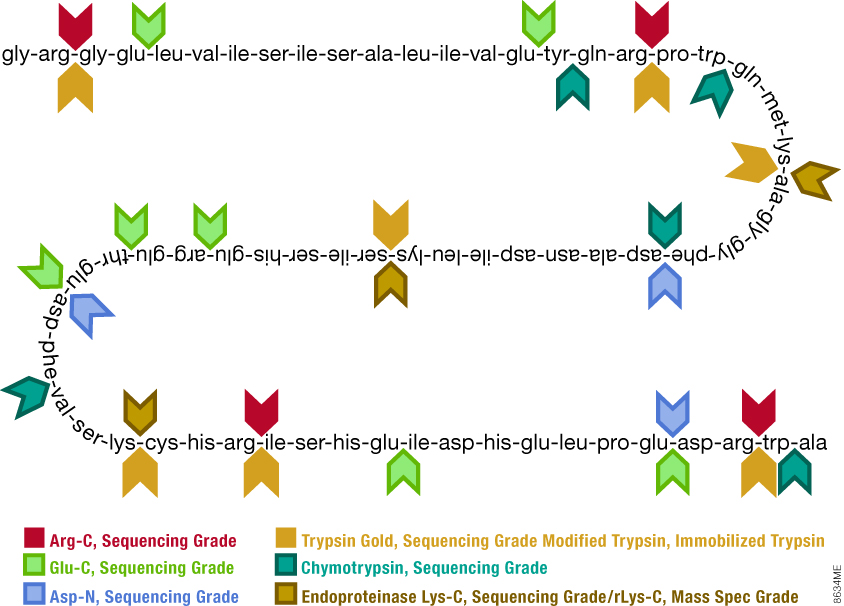
Digestion sites for a variety of trypsins and proteases.
What is Reductive Methylation, and How Does It Make Trypsin More Stable?
Reductive methylation modifies the lysine residues on trypsin itself, blocking the enzyme’s self-cleavage sites without affecting its activity toward substrate proteins. The result is a stable, highly active enzyme that resists autolysis throughout extended digestion incubations.
Trypsin cleaves at lysine and arginine residues—including those within its own structure. Reductive methylation adds methyl groups to the ε-amino groups of trypsin’s internal lysine residues, making them resistant to tryptic cleavage. This chemical modification does not alter the enzyme’s active site or its recognition of substrate Lys and Arg residues, so catalytic activity is preserved. The practical result: very few autolytic fragments appear in your digest. Because the enzyme cannot cleave itself, the peptide mixture you analyze reflects only your target protein—not breakdown products of the protease.
What Is TPCK Treatment, and Why Does It Matter for Proteomics?
Tosyl phenylalanyl chloromethyl ketone (TPCK) irreversibly inactivates chymotrypsin by blocking its active site. TPCK-treated trypsin preparations are free of chymotryptic activity, which eliminates nonspecific cleavages at aromatic and large hydrophobic residues that would otherwise generate unexpected peptides.
Commercially available porcine trypsin can contain trace chymotrypsin contamination co-purified from pancreatic extracts. Even small amounts of chymotrypsin can cause cleavage at Tyr, Phe, Trp and Leu residues—sites that should be intact in a tryptic digest. These nonspecific cleavages create peptides that don’t match expected tryptic fragments, increasing missed matches and reducing identification confidence. Sequencing Grade Modified Trypsin is treated with TPCK and then purified by affinity chromatography, providing a preparation with high tryptic specificity and no detectable chymotryptic activity.
Sequencing-Grade Modified Trypsin is only tested for stability and sequence specificity. Promega cannot guarantee that Sequencing-Grade Modified Trypsin will perform if used for mass spectrometry applications. Trypsin Gold and Trypsin Platinum are qualified for mass spectrometry applications. Each lot of the Trypsin Gold, Mass Spectrometry Grade (V5280) is qualified by mass spectrometry to ensure compatibility with your applications/instrumentation. For experiments requiring maximum digestion efficiency with the fewest missed cleavages—such as deep proteome coverage or large-scale quantitative datasets—consider Trypsin Platinum, Mass Spectrometry Grade (VA9000), which offers further optimized specifications for demanding mass spectrometry applications. See the product comparison table.
Which Promega Trypsin Is Right for My Proteomics Workflow?
Promega offers sequencing-grade and mass spectrometry (MS)-grade trypsin options optimized for different applications and levels of digest complexity. Sequencing Grade Modified Trypsin is a proven, versatile choice for most protein sequencing. Trypsin Gold is qualified for use in MS applications. Trypsin Platinum provides maximum specificity for demanding quantitative or low-abundance MS applications.
|
Feature |
Sequencing Grade Modified Trypsin (V5111) |
Trypsin Gold, Mass Spectrometry Grade (V5280) |
Trypsin Platinum, MS Grade (VA9000) |
|---|---|---|---|
|
Autolysis resistance |
Reductive methylation of Lys residues |
Reductive methylation of Lys residues |
Novel modification for maximum resistance to autoproteolysis |
|
Chymotrypsin inhibition |
TPCK treatment; affinity purified |
TPCK treatment; affinity purified |
Recombinant enzyme so no Chymotrypsin is present |
|
Recommended use |
Edman Degradation peptide sequencing |
General shotgun proteomics, in-gel and in-solution digestion prior to mass spectrometry |
Demanding quantitative workflows, deep proteome coverage by mass spectrometry |
|
Formats available |
Lyophilized (5×20μg, 1×100μg) or frozen (5×20μg) |
Lyophilized |
Lyophilized and frozen options |
|
Publications |
Thousands of peer-reviewed citations |
|
Validated for high-sensitivity MS workflows |
|
Denaturant tolerance |
0.1% SDS, 1M urea, 10% ACN; ~50% activity in 2M GuHCl |
|
|
Frequently Asked Questions
What is the cleavage specificity of Sequencing Grade Modified Trypsin?
Sequencing Grade Modified Trypsin cleaves specifically at the carboxyl side of lysine (Lys, K) and arginine (Arg, R) residues. This specificity is fully preserved by the reductive methylation modification. Cleavage does not occur when proline is C-terminal to the cleavage site (Lys-Pro or Arg-Pro bonds). Activity is also reduced when acidic residues flank the susceptible bond. These sequence-dependent missed cleavages are intrinsic to trypsin function and affect all tryptic preparations.
What ratio of trypsin to substrate protein is recommended?
Optimize the enzyme-to-substrate ratio typically between 1:100 to 1:20 final w/w (weight/weight). Higher ratios increase digest efficiency but may also increase autolytic background in preparations not treated with reducing agents.
How should Sequencing Grade Modified Trypsin be stored and resuspended?
Lyophilized formats (V5111, V5117) should be resuspended in the supplied Trypsin Resuspension Dilution Buffer (V542A) and stored according to the product information sheet. Frozen format (V5113) is supplied at 0.5mg/ml as a liquid and should be stored at −80°C. Avoid repeated freeze-thaw cycles. Refer to the Certificate of Analysis for lot-specific activity data.
What buffer conditions are compatible with trypsin activity?
Trypsin is maximally active in the pH range of 7 to 9 but is reversibly inactivated at pH 4. The enzyme tolerates mild denaturants used to improve protein solubility like 0.1% SDS, 1M urea, and 10% acetonitrile final concentrations.The recommended digestion buffers include 50mM NH4HCO3 (pH 7.8) or 50mM Tris-HCl, 1mM CaCl2 (pH 7.6).
Is there a faster digestion option for high-throughput workflows?
Yes. The Rapid-Digestion Trypsin and Trypsin/Lys-C Kits (VA1060, VA1061) are designed for streamlined workflows requiring faster digestion times—typically 1–2 hours rather than overnight—while maintaining specificity. These kits are well-suited for high-throughput proteomics sample preparation.
Specifications
Catalog Number:
What's in the box?
| Item | Part # | Size |
|---|---|---|
|
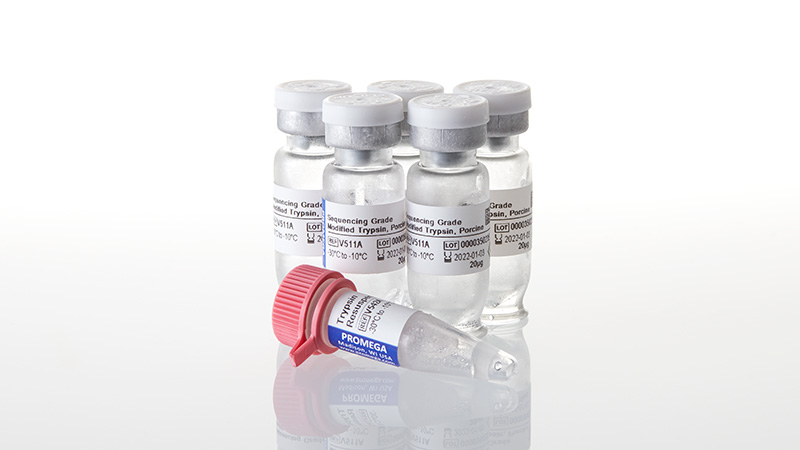
Sequencing Grade Modified Trypsin, Porcine (lyophilized) |
V511A | 5 × 20μg |
|
Trypsin Resuspension Dilution Buffer |
V542A | 1 × 1ml |
SDS
Search for SDSCertificate of Analysis
Use Restrictions
For Research Use Only. Not for Use in Diagnostic Procedures.Storage Conditions
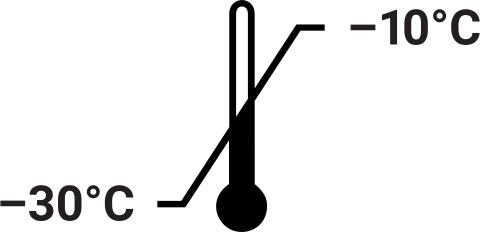
What's in the box?
| Item | Part # | Size |
|---|---|---|
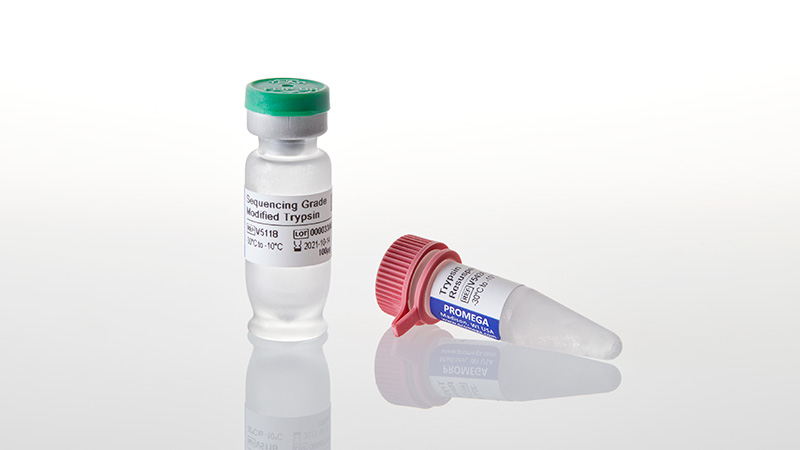
Sequencing Grade Modified Trypsin |
V511B | 1 × 100μg |
|
Trypsin Resuspension Dilution Buffer |
V542A | 1 × 1ml |
SDS
Search for SDSCertificate of Analysis
Use Restrictions
For Research Use Only. Not for Use in Diagnostic Procedures.Storage Conditions
What's in the box?
| Item | Part # | Size |
|---|---|---|
|
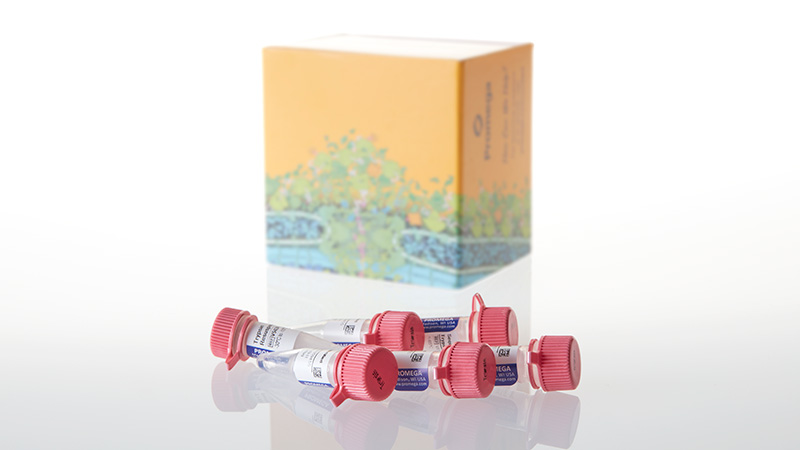
Sequencing Grade Modified Trypsin, Porcine, Frozen (liquid 0.5mg/ml) |
V511C | 5 × 20μg |
|
Trypsin Resuspension Dilution Buffer |
V542A | 1 × 1ml |
SDS
Search for SDSCertificate of Analysis
Use Restrictions
For Research Use Only. Not for Use in Diagnostic Procedures.Storage Conditions
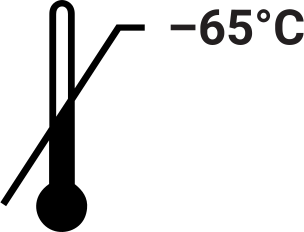
Related Products
Similar Products
Trypsin Platinum, Mass Spectrometry Grade
Maximum digest specificity. Maximum resistance to autoproteolysis.
VA9000
Endoglycosidase H
Characterize protein glycosylation in applications such as monitoring protein trafficking and determining glycan location and structure by mass spectrometry.
V4871, V4875
PNGase F
Catalyzes cleavage of N-linked oligosaccharides between the innermost GlcNAc and asparagine residues.
V4831
Trypsin/Lys-C Mix, Mass Spec Grade
Increased peptide recovery, enhanced protein quantitation, improved reproducibility.
V5071, V5072, V5073
Frequently Used With
Magnetic Proteomics Sample Prep (MPSP) Kit
Magnetic beads for streamlined, SP3-based proteomics sample preparation.
CS3325A04
Arg-C Ultra, Mass Spec Grade
Endopeptidase that cleaves at the C-terminus of arginine residues, including Arg-Pro.
VA1831, VA1832
Lys-C, Mass Spec Grade
Cleavage site: C-terminal of Lys. Optimal pH: 7–9.
VA1170
Chymotrypsin, Sequencing Grade
Cleavage sites: C-terminal of Tyr, Phe, Trp. Optimal pH: 7–9.
V1061, V1062