pGEM®-T Vector Systems
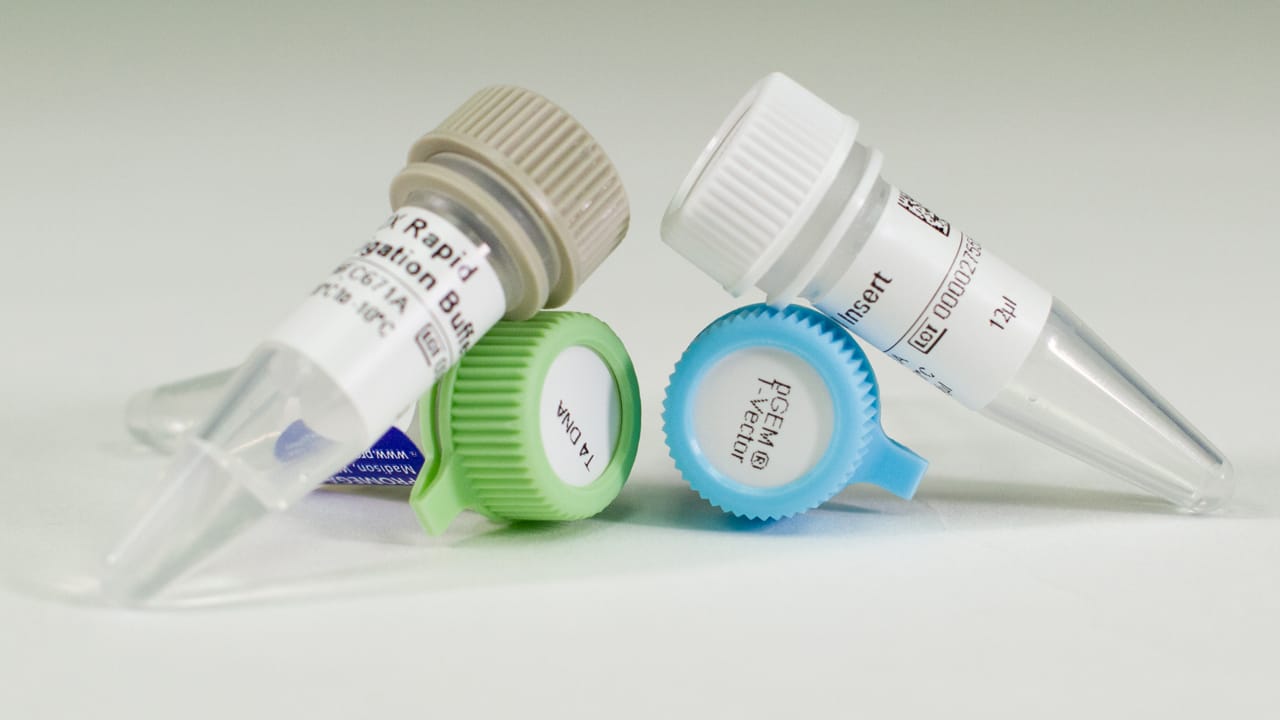

Convenience for Cloning PCR Products
- Insert excision with a BstZI single digest
- Ligation can be completed in 1 hour at room temperature
- Available with or without competent cells

Catalog Number:
Size
Add competent cells
Catalog Number: A3600
Catalog Number: A3610
Efficient T-Vector Cloning with Blue/White Selection
The pGEM®-T Vector Systems are convenient systems to clone PCR products generated by certain thermostable polymerases. These polymerases often add a single deoxyadenosine, in a template-independent fashion, to the 3´-ends of the amplified fragments. The pGEM®-T Vector is ready to use in ligation reactions, prepared by cutting the pGEM®-5Zf(+) Vector with EcoRV and adding a 3´ terminal thymidine to both ends. These single 3´-T overhangs at the insertion site greatly improve the efficiency of ligation of a PCR product into the plasmid by preventing recircularization of the vector and providing a compatible overhang for ligation of PCR products with A overhangs.
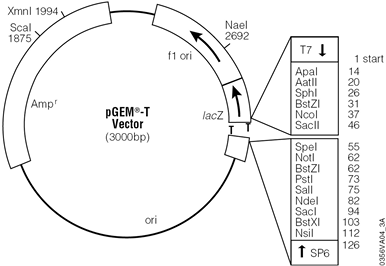
The pGEM®-T Vector is derived from the pGEM®-5Zf(+) Vector (GenBank® Accession No. X65308). The pGEM®-T Vector was created by linearizing the pGEM®-5Zf(+) Vector with EcoRV at base 51 and adding a T to both 3´-ends. The position of the T is indicated by * in the pGEM®-T Vector Sequence (.txt).
In the pGEM®-T Vector, T7 and SP6 RNA polymerase promoters flank a multiple cloning region within the α-peptide coding region for β-galactosidase. Insertional inactivation of the α-peptide allows recombinant clones to be directly identified by Blue/White Screening on indicator plates. The vector allows preparation of single-stranded DNA due to its f1 Origin of Replication.
The multiple cloning site is flanked by recognition sites for the restriction enzyme BstZI, allowing release of the insert by a single-enzyme digestion. Alternatively, a double digestion may be used to release the insert from the vector.
The pGEM®-T Vector System II contains JM109 Competent Cells in addition to all of the pGEM®-T Vector System I components.
References
- Mezei, L.M. and Storts, D.R. (1994) In: PCR Technology: Current Innovations, Griffin, H.G. and Griffin, A.M., eds., CRC Press, Boca Raton, FL, 21.
- Robles, J. and Doers, M. (1994) Promega Notes 45, 19–20.
- Clark, J.M. (1988) Nucl. Acids Res. 16, 9677–86.
- Newton, C.R. and Graham, A. (1994) In: PCR, BIOS Scientific Publishers, Ltd., Oxford, UK, 13.
Protocols
Specifications
Catalog Number:
What's in the box?
| Item | Part # | Size | Available Separately |
|---|---|---|---|
|
pGEM®-T Vector |
A362A | 1 × 1.2μg | |
|
Control Insert DNA |
A363A | 1 × 12μl | |
|
2X Rapid Ligation Buffer |
C671A | 1 × 200μl | View Product |
|
T4 DNA Ligase |
M180A | 1 × 100u |
SDS
Search for SDSCertificate of Analysis
Use Restrictions
For Research Use Only. Not for Use in Diagnostic Procedures.Storage Conditions

See Protocol for detailed storage recommendations.
What's in the box?
| Item | Part # | Size | Available Separately |
|---|---|---|---|
|
pGEM®-T Vector |
A362A | 1 × 1.2μg | |
|
Control Insert DNA |
A363A | 1 × 12μl | |
|
2X Rapid Ligation Buffer |
C671A | 1 × 200μl | View Product |
|
JM109 Competent Cells, High Efficiency |
L200A | 6 × 200μl | |
|
T4 DNA Ligase |
M180A | 1 × 100u |
SDS
Search for SDSCertificate of Analysis
Use Restrictions
For Research Use Only. Not for Use in Diagnostic Procedures.Storage Conditions
See Protocol for detailed storage recommendations.
Resources
Related Products
Similar Products
Frequently Used With
Molecular Biology Lab Guide
A resource designed for scientists just embarking on their career, focusing on fundamental technologies and techniques.
GEN1978
GoTaq® G2 Master Mixes
Second-generation, high-performance GoTaq® G2 DNA Polymerase in a ready-to-use master mix.
M7822, M7823, M7832, M7833
GoTaq® G2 Hot Start Master Mixes
Ready-to-use optimized master mix for room-temperature PCR assembly. Contains GoTaq® G2 enzyme.
M7422, M7423, M7432, M7433
GoTaq® G2 DNA Polymerase
Latest generation GoTaq® polymerase—high-performance for your everyday PCR needs.
M7841, M7845, M7848